Retail Fire Alarm Systems –
Retail businesses across Leeds operate in fast-moving environments where customer safety, staff protection and operational continuity all depend on reliable fire safety systems. Whether running a high street shop, shopping centre unit, showroom or large retail warehouse, having an effective commercial fire alarm system is essential for protecting both people and business operations.
Retail premises present a unique combination of fire risks. Public access, electrical equipment, display lighting, storage rooms and stock areas all create potential hazards that require carefully planned fire detection. In many retail environments, occupancy levels can also fluctuate significantly throughout the day, making rapid fire detection and clear evacuation procedures especially important.
For busy retail premises, every second counts during an emergency.
One of the main challenges in retail fire safety is balancing customer experience with practical protection measures. Fire alarm systems must provide fast and reliable warning while minimising false alarms that can disrupt trading, cause unnecessary evacuations and affect customer confidence.
Older systems are often more vulnerable to false activations caused by dust, environmental conditions or ageing detectors. In busy retail settings, repeated unwanted alarms can quickly become costly and disruptive.
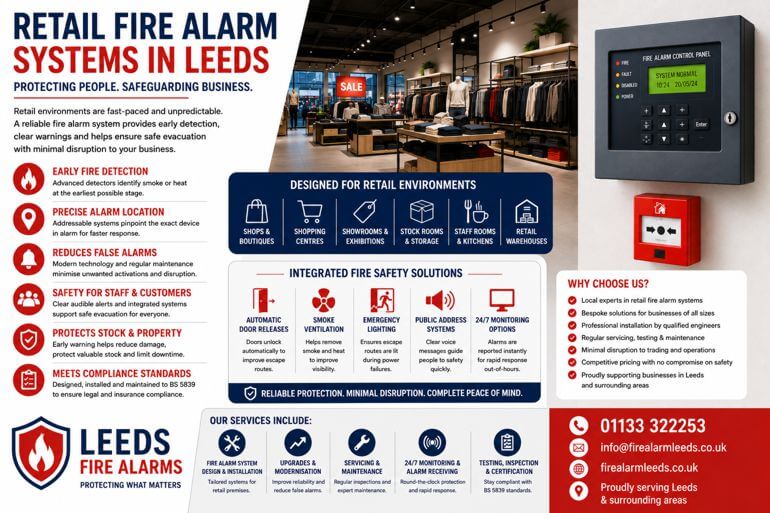
Modern commercial fire alarm systems use improved detector technology and intelligent monitoring to reduce these risks significantly. Addressable systems can identify the exact detector or device in alarm, allowing staff and emergency responders to locate issues quickly and accurately.
This becomes especially valuable in larger retail premises where locating an activation manually could otherwise delay response times.
Retail premises in Leeds frequently contain a mix of public and non-public areas including shop floors, stock rooms, offices, kitchens and plant areas. Each of these spaces may require different types of fire detection depending on the environment and level of risk.
For example, heat detectors may be more suitable in staff kitchen areas, while optical smoke detection may provide better coverage for customer-facing spaces and storage rooms.
Shopping centres and multi-unit retail developments introduce additional considerations. Shared escape routes, integrated safety systems and coordinated evacuation procedures all require fire alarm systems to operate reliably within a wider building infrastructure.
Modern commercial fire alarm systems can integrate with emergency lighting, smoke ventilation systems, magnetic door releases and public address systems to improve evacuation efficiency and overall site safety.
Retail businesses also rely heavily on electrical infrastructure including tills, digital displays, lighting systems and security equipment. Electrical faults remain one of the most common causes of commercial fires, particularly in premises operating long trading hours or high equipment loads.
Early detection is therefore critical to reducing damage and protecting business continuity.
For many retailers, out-of-hours protection is equally important. Fires developing overnight may otherwise remain undetected until serious damage has already occurred. Monitored fire alarm systems provide additional reassurance by ensuring activations are automatically reported to alarm receiving centres for rapid response.
This can be particularly important for retailers storing valuable stock or operating from city centre locations where fire spread could affect neighbouring businesses.
Routine maintenance plays a major role in ensuring retail fire alarm systems remain reliable. Under BS 5839 recommendations, commercial systems should be regularly inspected, tested and serviced to identify faults before they create larger problems.
Detector contamination, failing batteries and communication faults are all common issues that can develop gradually over time if systems are not properly maintained.
Retail premises also regularly undergo layout changes as displays, shelving and stock arrangements evolve throughout the year. Seasonal displays, promotional stands and operational changes can all affect detector coverage and evacuation routes. Fire alarm systems should therefore be reviewed periodically to ensure protection remains suitable for the building’s current layout and occupancy levels.
Commercial insurers increasingly expect retail businesses to maintain professionally serviced and compliant fire alarm systems. Proper documentation, maintenance records and ongoing testing help demonstrate that fire safety responsibilities are being managed appropriately.
Businesses searching for Fire Alarms Leeds services are increasingly focused on modernisation, long-term reliability and proactive maintenance support rather than simply minimum compliance.
A professionally designed commercial fire alarm system helps reduce operational disruption, improve customer safety and support smoother day-to-day business management.
Whether protecting independent retailers, shopping centre units or larger showroom premises, investing in reliable commercial fire alarm systems remains one of the most important steps any retail business can take to protect staff, customers and property.