Fire Alarm Networking –
As commercial buildings become larger and more complex, fire alarm systems must evolve to provide greater levels of control, visibility and resilience. One technology increasingly found within larger commercial premises is fire alarm networking.
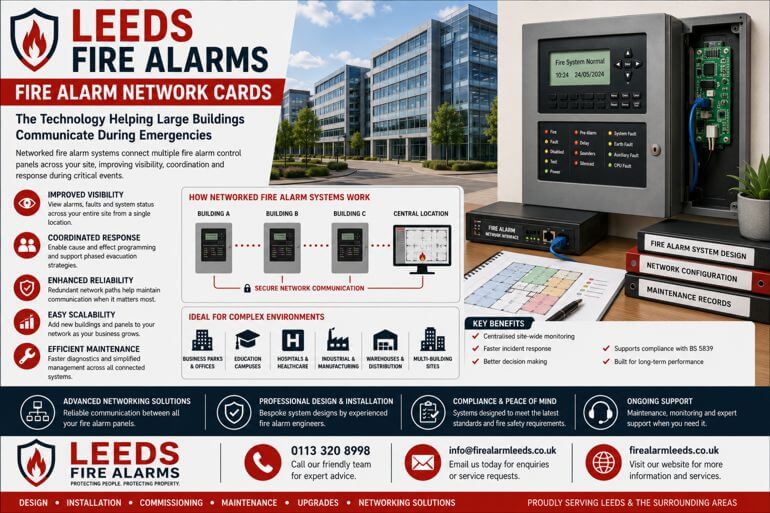
For businesses operating across multiple buildings, large campuses, distribution centres, educational facilities and healthcare environments, networked fire alarm systems allow multiple control panels to communicate as a single integrated system.
At the heart of this capability are network cards. Whilst rarely seen by building occupants, these devices play an important role in ensuring fire alarm information can be shared quickly and reliably throughout a site.
Across Leeds, many larger commercial premises are now benefiting from the flexibility and operational advantages that fire alarm networking provides.
What Is a Fire Alarm Network Card?
A network card is a communication module installed within a fire alarm control panel.
Its purpose is to allow individual fire alarm panels to exchange information with other panels across a network.
Rather than operating independently, multiple panels can communicate and share critical information including:
• Alarm activations
• Fault conditions
• Device status
• System events
• Evacuation signals
• Cause and effect functions
This creates a coordinated fire alarm system across the entire premises.
Why Are Networked Fire Alarm Systems Used?
Large commercial buildings often require more than one fire alarm control panel.
Examples include:
• Multi-building business parks
• Universities
• Hospitals
• Manufacturing facilities
• Distribution centres
• Large office developments
• Educational campuses
Without networking, each panel operates separately.
Networking allows information to be shared instantly between locations, improving management and emergency response.
Improving Visibility Across Large Sites
One of the biggest advantages of networking is centralised visibility.
A facilities manager may be able to view fire alarm events occurring anywhere on site from a single location.
This can help:
• Speed up investigations
• Improve incident management
• Reduce response times
• Simplify system administration
For larger sites, this level of oversight can be extremely valuable.
Supporting Phased Evacuation Strategies
Many complex buildings utilise phased evacuation procedures.
Rather than evacuating an entire site immediately, specific areas may be evacuated first depending on the location of the incident.
Networked fire alarm systems can support sophisticated cause and effect programming that coordinates alarm responses across multiple buildings or zones.
This helps create a more structured and controlled evacuation process.
Improving System Resilience
Modern fire alarm networks are designed with reliability in mind.
Depending on the system architecture, communication pathways may include redundancy features that help maintain operation even if part of the network becomes unavailable.
This additional resilience is particularly important within critical environments such as:
• Healthcare facilities
• Data centres
• Manufacturing plants
• High-occupancy commercial buildings
System reliability remains a key consideration during the design process.
Simplifying Future Expansion
Businesses rarely remain static.
New buildings are constructed, departments relocate and sites expand.
Networked fire alarm systems often make future expansion easier because additional panels can be incorporated into the existing infrastructure.
This provides greater flexibility compared with operating multiple independent systems.
Supporting Maintenance Activities
Fire alarm maintenance can also benefit from networking.
Engineers may be able to access system information more efficiently, review event histories and identify faults across the network.
This can help reduce maintenance time whilst providing greater visibility of overall system performance.
The Importance of Professional Design
Fire alarm networking introduces additional complexity that requires careful planning.
Design considerations include:
• Building layout
• Network architecture
• Communication pathways
• Fire strategy requirements
• Future expansion plans
• System resilience
A properly designed networked system should support both operational requirements and life safety objectives.
Choosing the right network structure at the outset can deliver significant long-term benefits.
Commercial Fire Alarm Solutions in Leeds
At Fire Alarm Leeds, we design, install, commission and maintain advanced commercial fire alarm systems for businesses throughout Leeds and the surrounding areas.
Whether you operate a multi-building site, educational campus, industrial facility or large commercial premises, our experienced engineers can advise on networked fire alarm solutions that improve visibility, resilience and long-term scalability.
From system design through to ongoing maintenance, we help businesses implement reliable fire alarm infrastructure that supports both compliance and operational efficiency.