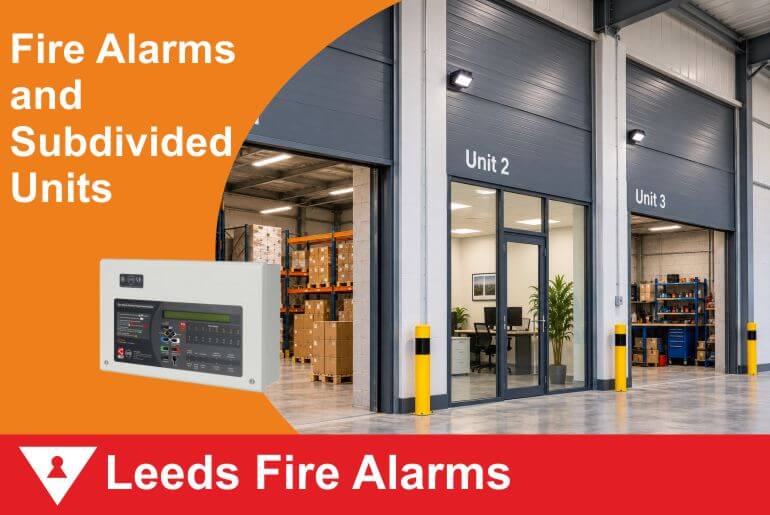
A large commercial building does not necessarily remain occupied by one business throughout its life.
Warehouses are divided into smaller industrial units. Office floors are split between separate companies. Retail premises are subdivided, and former factories can become multi-occupancy business centres containing several completely independent organisations.
The physical alterations may appear straightforward, but an existing fire alarm system can become considerably more complicated when one premises becomes several.
For commercial property owners and businesses in Leeds, subdivision raises an important question: does the original fire alarm arrangement still make sense now that different companies occupy different parts of the building?
The Existing System Was Designed for a Different Building
Consider a large industrial unit originally occupied by one company.
It may have one fire alarm control panel, detection throughout the premises and alarm sounders designed to warn everybody simultaneously.
The building is later divided into three units.
New walls are constructed, separate entrances are created and three unrelated businesses move in.
Although the external building may look almost unchanged, its day-to-day operation is now completely different.
The fire alarm arrangements need to be reviewed as part of that change.
Should Everyone Hear the Same Alarm?
One of the first considerations is how occupants should be warned if a fire occurs.
If the building’s fire strategy requires all occupiers to evacuate when the alarm operates anywhere within the premises, the fire alarm needs to provide that warning reliably throughout all the units.
New separating walls can affect sound levels considerably.
A sounder that was perfectly adequate when the warehouse was open-plan may no longer provide sufficient warning after substantial partitions have been constructed.
New offices, workshops and storage rooms can therefore require changes to alarm warning as well as additional detection.
Separate Occupiers Create Management Questions
A single business normally has clear responsibility for its own weekly fire alarm testing, fault reporting and maintenance arrangements.
Multi-occupancy premises can be less straightforward.
Who carries out the weekly test?
Who contacts the fire alarm company when a fault appears?
Who has access to the control panel?
What happens if one occupier is closed when an engineer needs access?
These are management questions rather than simply technical ones, but they can have a significant effect on how effectively the fire alarm is maintained.
Responsibilities should be established rather than assumed.
Access to the Fire Alarm Panel Matters
Subdivision can sometimes leave the original fire alarm control panel inside one tenant’s premises.
That may have been perfectly logical when the building had a single occupier.
Once the building is divided, however, access can become problematic.
If another business reports a fault outside the first tenant’s opening hours, can the responsible person reach the panel?
Fire alarm controls and indications need to be accessible to the people responsible for managing the system.
This should be considered when planning the subdivision rather than discovered after tenants have moved in.
Detection Coverage Changes With New Walls
Adding internal partitions can create entirely new rooms.
A detector positioned centrally within a large open space may not provide appropriate coverage after walls have been constructed around it.
Some newly created rooms may require their own detection, depending upon the system category and fire strategy.
Ceiling changes can have similar consequences.
The fact that the original building had adequate detection does not mean the subdivided building automatically does.
One System or Separate Systems?
There is no universal answer to whether subdivided premises should retain one common fire alarm or use separate systems.
The appropriate arrangement depends upon factors such as the construction of the building, fire strategy, escape arrangements and relationship between the individual occupancies.
In some premises, a common fire alarm may remain appropriate.
In others, independent systems with carefully considered interaction may be required.
The decision should follow the building’s fire safety requirements rather than simply whichever option appears easiest during the refurbishment.
Shared Areas Must Not Be Forgotten
Multi-occupancy commercial buildings often retain shared spaces.
These can include entrance halls, staircases, corridors, toilets, plant rooms and service areas.
Even if individual businesses occupy clearly defined units, these common areas still need to form part of the overall fire alarm assessment.
Responsibility for maintaining equipment within them also needs to be clear.
A fault in a shared staircase detector, for example, should not fall into a gap where every tenant assumes somebody else is dealing with it.
What Happens When One Unit Is Empty?
Commercial occupancy changes frequently.
One unit may become vacant while neighbouring businesses continue trading.
The fire alarm arrangements cannot simply be ignored because nobody currently works inside the empty space.
Depending upon the building arrangement, a fire developing in a vacant unit could still present a risk to adjoining occupiers.
Maintaining appropriate fire detection during vacant periods can therefore remain important.
Future Tenant Alterations Can Cause Further Changes
Subdivision is rarely the end of the process.
A new tenant may install offices, alter ceilings, add meeting rooms or change storage arrangements before opening.
Another tenant might operate a workshop where the previous occupant ran a quiet warehouse.
These individual fit-outs can affect detection and alarm warning within each unit.
Landlords and tenants therefore benefit from establishing how fire alarm alterations will be managed before different contractors begin modifying the system independently.
Avoid Creating a Patchwork Fire Alarm
Over many years, multi-occupancy buildings can accumulate numerous fire alarm alterations.
Devices are added, circuits extended and tenant layouts changed.
Without proper control, the result can become difficult to understand and maintain.
Accurate system information and professionally planned alterations help ensure that the fire alarm remains a coherent installation rather than becoming a collection of modifications made by different contractors at different times.
Commercial Fire Alarm Systems in Leeds
At Leeds Fire Alarms, we design, install, service and alter commercial fire alarm systems throughout Leeds and the surrounding area.
If you are dividing a warehouse, office building, industrial property or other commercial premises into separate units, the existing fire alarm should be reviewed as part of the project.
Detection coverage, sounder coverage, control-panel access and the relationship between individual occupiers can all change when one premises becomes several.
For commercial fire alarm advice in Leeds, call 01133 322253 or email [email protected].